[:en]Persepolis[:de]Persepolis[:fr]Persépolis[:]
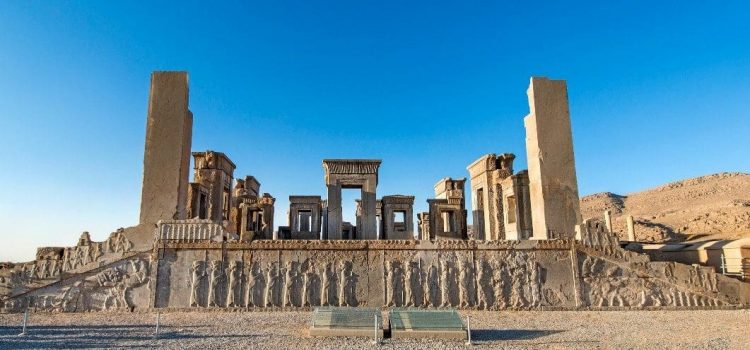
[:en]Founded by Darius I in 518 B.C., Persepolis was the capital of the Achaemenid Empire. It was built on an immense half-artificial, half-natural terrace, where the king of kings created an impressive palace complex inspired by Mesopotamian models. The importance and quality of the monumental ruins make it a unique archaeological site.
Brief Synthesis
Persepolis, whose magnificent ruins rest at the foot of Kuh-e Rahmat (Mountain of Mercy) in south-western Iran, is among the world’s greatest archaeological sites. Renowned as the gem of Achaemenid (Persian) ensembles in the fields of architecture, urban planning, construction technology, and art, the royal city of Persepolis ranks among the archaeological sites which have no equivalent and which bear unique witness to a most ancient civilization. The city’s immense terrace was begun about 518 BCE by Darius the Great, the Achaemenid Empire’s king. On this terrace, successive kings erected a series of architecturally stunning palatial buildings, among them the massive Apadana palace and the Throne Hall (“Hundred-Column Hall”).
Inspired by Mesopotamian models, the Achaemenid kings Darius I (522-486 BCE), his son Xerxes I (486-465 BCE), and his grandson Artaxerxes I (465-424 BCE) built a splendid palatial complex on an immense half-natural, half-artificial terrace. This 13-ha ensemble of majestic approaches, monumental stairways, throne rooms (Apadana), reception rooms, and dependencies is classified among the world’s greatest archaeological sites. The terrace is a grandiose architectural creation, with its double flight of access stairs, walls covered by sculpted friezes at various levels, contingent Assyrianesque propylaea (monumental gateway), gigantic sculpted winged bulls, and remains of large halls. By carefully engineering lighter roofs and using wooden lintels, the Achaemenid architects were able to use a minimal number of astonishingly slender columns to support open area roofs. Columns were topped with elaborate capitals; typical was the double-bull capital where, resting on double volutes, the forequarters of two kneeling bulls, placed back-to-back, extend their coupled necks and their twin heads directly under the intersections of the beams of the ceiling.
Persepolis was the seat of government of the Achaemenid Empire, though it was designed primarily to be a showplace and spectacular centre for the receptions and festivals of the kings and their empire. The terrace of Persepolis continues to be, as its founder Darius would have wished, the image of the Achaemenid monarchy itself, the summit where likenesses of the king reappear unceasingly, here as the conqueror of a monster, there carried on his throne by the downtrodden enemy, and where lengthy cohorts of sculpted warriors and guards, dignitaries, and tribute bearers parade endlessly.
Criterion (i): The terrace of Persepolis, with its double flight of access stairs, its walls covered by sculpted friezes at various levels, contingent Assyrianesque propylaea, the gigantic winged bulls, and the remains of large halls, is a grandiose architectural creation. The studied lightening of the roofing and the use of wooden lintels allowed the Achaemenid architects to use, in open areas, a minimum number of astonishingly slender columns (1.60 metres in diameter vis-à-vis a height of about 20 metres). They are surmounted by typical capitals where, resting on double volutes, the forequarters of two kneeling bulls, placed back-to-back, extend their coupled necks and their twin heads, directly under the intersections of the beams of the ceiling.
Criterion (iii): This ensemble of majestic approaches, monumental stairways, throne rooms (Apadana), reception rooms, and annex buildings is classified among the world’s greatest archaeological sites, among those which have no equivalent and which bear witness of a unique quality to a most ancient civilization.
Criterion (vi): The terrace of Persepolis continues to be, as its founder Darius would have wished, the image of the Achaemenid monarchy itself, the summit where likenesses of the king reappear unceasingly, here as the conqueror of a monster, there carried on his throne by the downtrodden enemy, and where lengthy cohorts of sculpted warriors and guards, dignitaries, and tribute bearers parade endlessly.
Integrity
Within the boundaries of the property are located the known elements and components necessary to express the Outstanding Universal Value of the property, including the archaeological remains of the terrace and of its related royal palaces and buildings.
The most significant identified challenge to the integrity of the property and its buffer zone is controlling its borders and boundaries against agricultural, industrial, and constructional development. The principal potential threats are the growth of Marvdasht town, new village developments, and the arrival of polluting industries. These threats are considered to be increasing.
Authenticity
The archaeological ruins at Persepolis are authentic in terms of their locations and setting, materials and substance, and forms and design. The present location of the Persepolis terrace and its related buildings has not changed over the course of time. Restoration work has carefully respected the authenticity of the monuments, utilizing traditional technology and materials in harmony with the ensemble. No changes have been made to the general plan of Persepolis. Moreover, there are no modern reconstructions at Persepolis; the remains of all the monuments are authentic.
Protection and management requirements
The Persepolis Ensemble was registered in the national list of Iranian monuments as item no. 20 on the 24th of the month Shahrivar, 1310 SAH (15 September 1931). Relevant national laws and regulations concerning the property include the National Heritage Protection Law (1930, updated 1998) and the 1980 Legal bill on preventing clandestine diggings and illegal excavations. The inscribed World Heritage property, which is owned by the Government of Iran, and its buffer zone are under the legal protection and management of the Iranian Cultural Heritage, Handicrafts and Tourism Organization (which is administered and funded by the Government of Iran). The property and buffer zone are also under a regional master plan with its own regulations. A management plan covering the identification of borders, buffer zone, land ownership, conservation priorities, and time-tabled management interventions was introduced in 2001. Persepolis Research Base, a management and conservation office established in Persepolis in 2001, is responsible for the investigation, conservation, restoration, reorganization, and presentation of the property. Training and skills upgrading are offered by the office in cooperation with universities and scientific institutes in Iran and abroad. Financial resources for Persepolis are provided through national and provincial budgets, and site admission fees.
Sustaining the Outstanding Universal Value of the property over time will require creating monitoring and evaluation systems for air pollutants, weathering, and environmental factors; controlling the borders and boundaries of the property against agricultural, industrial, and constructional development; developing indicators for measuring the effects of the potential growth and development of Marvdasht town and new villages; and investigating, evaluating, and eliminating any negative impact such growth and development that may have on the Outstanding Universal Value, integrity or authenticity of the property.[:de]Persepolis wurde 518 von Darius I. Gegründet. Persepolis war die Hauptstadt des Achaimenidenreiches. Es wurde auf einer riesigen halb-künstlichen, halb-natürlichen Terrasse ,wo der König der Könige einen eindrucksvollen Palastkomplex schuf, errichtet .Der wurde von mesopotamischen Modellen inspiriert. Die Bedeutung und Qualität der monumentalen Ruinen machen es zu einer einzigartigen archäologischen Stätte.
Kurze Zusammensetzung Persepolis, dessen prachtvolle Ruinen am Fuße des Kuh-e Rahmat (Berg der Barmherzigkeit) im südwestlichen Iran liegen, gehört zu den größten archäologischen Stätten der Welt. Die königliche Stadt Persepolis gilt als das Juwel achaimenidischer (persischer) Zusammensetzung von Architektur, Stadtplanung, Bautechnik und Kunst. Sie gehört zu den archäologischen Stätten, die kein gleichwertiges Beispiel haben, und die ein einzigartiges Zeugnis einer ältesten Zivilisation sind. Der Bau der immense Terrasse der Stadt wurde um 518 v. Chr. von Darius dem Großen begonnen. Auf dieser Terrasse errichteten aufeinanderfolgende Könige eine Reihe architektonisch beeindruckender palastartiger Gebäude, darunter der massive Apadana-Palast und der Thronsaal (“Hundertspaltige Halle”).Inspiriert von mesopotamischen Vorbildern errichteten die Achämeniden-Könige Darius I. (522-486 v. Chr.), sein Sohn Xerxes I. (486-465 v. Chr.) und sein Enkel Artaxerxes I. (465-424 v. Chr.) einen prachtvollen palastartigen Komplex. Dieses 13 Hektar große Zusammensetzung aus majestätischen Ansätzen, monumentalen Treppenhäusern, Thronsälen (Apadana), Empfangsräumen und Nebengebäuden gehört zu den größten archäologischen Stätten der Welt. Die Terrasse ist eine grandiose architektonische Schöpfung, mit einer doppelten Flucht der Zugangstreppen. Wände sind mit geformten Friesen auf verschiedenen Niveaus bedeckt,und mit Kontingent Assyrianese Propyläe (monumentales Tor), riesige gemeißelte geflügelte Stiere bestückt. Durch die sorgfältige Konstruktion hellerer Dächer und die Verwendung von Holzstürzen konnten die Architekten der Achämeniden eine minimale Anzahl von erstaunlich schlanken Säulen für offene Dächer verwenden. Die Säulen waren mit kunstvollen Kapitellen versehen. Typisch war das Doppelbullenkapital, die auf zwei Voluten ruhenden Vorderteile Rücken an Rücken angeordnet waren, und ihre gekoppelten Hälse und ihre Zwillingsköpfe direkt unter den Schnittpunkten der Deckenbalken ausstreckten.
Persepolis war der Sitz der Regierung des Achämenidenreiches, obwohl es in erster Linie als Schauplatz und spektakuläres Zentrum für die Empfänge und Feste der Könige gedacht war. Die Terrasse von Persepolis ist, wie ihr Gründer Darius sich gewünscht hätte, das Bild der achämenidischen Monarchie selbst.Auf dem Gipfel tauchen unaufhörlich Bildnisse des Königs wieder auf,die als Bezwinger eines Monstrums, auf dem Thron der Unterdrückten Feind, und wo lange Kohorten von gemeißelten Kriegern und Wachen, Würdenträgern und Tribünenträgern endlos paradieren.
Kriterium (i): Die Terrasse von Persepolis, mit ihren doppelten Treppenfluchten, ihren mit Relieffriesen verzierten Wänden auf verschiedenen Ebenen, kontingenten assyrischen Propyläen, den riesigen Flügelbullen und den Überresten großer Hallen ist eine grandiose architektonische Schöpfung. Die studierte Aufhellung des Daches und die Verwendung von Holzstürzen erlaubten den Architekten der Achämeniden in offenen Gebieten eine minimale Anzahl von erstaunlich schlanken Säulen zu verwenden (1,60 Meter im Durchmesser gegenüber einer Höhe von etwa 20 Metern)..
Kriterium (iii): Dieses Ensemble aus majestätischen Ansätzen, monumentalen Treppenhäusern, Thronsälen (Apadana), Empfangsräumen und Nebengebäuden gehört zu den größten archäologischen Stätten der Welt, zu denen es keine Entsprechungen gibt .
Kriterium (vi): Die Terrasse von Persepolis bleibt, wie ihr Gründer Darius sich gewünscht hätte, das Bild der Achämeniden-Monarchie selbst.Auf dem Gipfel tauchen unaufhörlich Bildnisse des Königs wieder auf.
Integrität
Innerhalb der Grenzen der Anlage befinden sich die bekannten Elemente und Komponenten, die notwendig sind, um den außergewöhnlichen universellen Wert des Eigentums einschließlich der archäologischen Überreste der Terrasse und der damit verbundenen königlichen Paläste und Gebäude auszudrücken.Die wichtigste identifizierte Herausforderung für die Integrität der Anlage ist die Kontrolle seiner Grenzen gegenüber der landwirtschaftlichen, industriellen und baulichen Entwicklung. Die größten potentiellen Gefahren sind das Wachstum der Stadt Marvdasht, neue Dorfentwicklungen und die Ankunft von umweltschädlichen Industrien. Diese Bedrohungen werden als zunehmend angesehen.
Authentizität
Die archäologischen Ruinen in Persepolis sind authentisch in Bezug auf ihre Lage und Umgebung, Materialien und Substanz sowie Formen und Design. Der heutige Standort der Persepolis-Terrasse und der dazugehörigen Gebäude haben sich im Laufe der Zeit nicht verändert. Restaurierungsarbeiten haben die Authentizität der Denkmäler sorgfältig respektiert, wobei traditionelle Techniken und Materialien in Harmonie mit dem Ensemble verwendet wurden. Am Generalplan von Persepolis wurden keine Änderungen vorgenommen. Außerdem gibt es in Persepolis keine modernen Rekonstruktionen. Die Überreste aller Denkmäler sind authentisch.
Schutz- und Managementanforderungen
Das Persepolis Ensemble wurde in die nationale Liste der iranischen Monumente als Nr. 20 am 24. des Monats Shahrivar, 1310 SAH(15. September 1931) registriert. Zu den maßgeblichen nationalen Gesetzen und Vorschriften in Bezug auf das Grundstück gehören das Gesetz zum Schutz des nationalen Erbes (1930, aktualisiert 1998) und das Gesetzesgesetz von 1980 zur Verhinderung von illegalen Ausgrabungen. Das eingeschriebene Welterbe ist das Eigentum der iranischen Regierung .Seine Pufferzone stehen unter dem rechtlichen Schutz und der Verwaltung der iranischen Organisation für Kulturerbe, Handwerk und Tourismus (die von der iranischen Regierung verwaltet und finanziert wird). Die Anlage und die Pufferzone unterliegen ebenfalls einem regionalen Masterplan mit eigenen Vorschriften. Im Jahr 2001 wurde ein Bewirtschaftungsplan, der die Festlegung von Grenzen, Pufferzonen, Landbesitz, Schutzprioritäten und zeitgesteuerte Managementinterventionen vorsieht,eingefürt.Der Forschungsbasis von Persepolis ist ein in 2001 eingerichtetes Management- und Naturschutzbüro, das für die Untersuchung, Konservierung, Restaurierung, Reorganisation und Präsentation der Immobilie verantwortlich ist. Schulungen und Qualifizierungsmaßnahmen werden vom Büro in Zusammenarbeit mit Universitäten und wissenschaftlichen Instituten im Iran und im Ausland angeboten. Die finanziellen Mittel für Persepolis werden aus den nationalen und regionalen Budgets und den Gebühren für die Aufnahme vor Ort bereitgestellt.
Um den außergewöhnlichen universellen Wert der Immobilie im Laufe der Zeit aufrechtzuerhalten, müssen Überwachungs- und Bewertungssysteme für Luftschadstoffe, Verwitterung und Umweltfaktoren geschaffen werden. Kontrolle der Grenzen der Anlage gegen landwirtschaftliche, industrielle und bauliche Entwicklung benötigen Entwicklung von Indikatoren zur Messung der Auswirkungen des potenziellen Wachstums und der Entwicklung der Stadt Marvdasht und neuer Dörfer.[:fr][vc_row][vc_column][vc_column_text]Fondée par Darius Ier en 518 av. J.-C., Persépolis était la capitale de l’empire des Achéménides. Il a été construit sur une immense terrasse mi-artificielle, mi-naturelle, où le roi des rois a créé un impressionnant complexe de palais inspiré des modèles mésopotamiens. L’importance et la qualité des ruines monumentales en font un site archéologique unique.
Brève synthèse
Persépolis, dont les ruines magnifiques reposent au pied de Kuh-e Rahmat (montagne de la Miséricorde) dans le sud-ouest de l’Iran, est l’un des plus importants sites archéologiques du monde. Reconnue comme le joyau des ensembles achéménides (persans) dans les domaines de l’architecture, de l’urbanisme, de la technologie de la construction et des arts, la ville royale de Persépolis figure parmi les sites archéologiques sans équivalent et qui témoignent de manière unique d’une civilisation très ancienne. L’immense terrasse de la ville fut commencée vers 518 avant notre ère par Darius le Grand, roi de l’empire achéménide. Sur cette terrasse, les rois successifs ont érigé une série de palais somptueux sur le plan architectural, parmi lesquels l’imposant palais Apadana et la salle du trône (la «salle aux cent colonnes»).
Inspirés par les modèles mésopotamiens, les rois achéménides Darius Ier (522-486 AEC), son fils Xerxès Ier (486-465 AEC) et son petit-fils Artaxerxès Ier (465-424 AEC) construisirent un splendide complexe palatial sur un immense terrasse semi-artificielle. Cet ensemble de 13 hectare d’approches majestueuses, d’escaliers monumentaux, de salles du trône (Apadana), de salles de réception et de dépendances est classé parmi les plus grands sites archéologiques du monde. La terrasse est une création architecturale grandiose, avec son double escalier d’accès, ses murs couverts de frises sculptées à divers niveaux, ses propylées assyrianesques (porte monumentale), ses gigantesques taureaux ailés sculptés et ses vestiges de grandes salles. En construisant soigneusement des toits plus légers et en utilisant des linteaux en bois, les architectes achéménides ont pu utiliser un nombre minimal de colonnes étonnamment fines pour soutenir les toits à ciel ouvert. Les colonnes étaient surmontées de chapiteaux élaborés; La capitale des doubles taureaux est typique: là où deux taureaux agenouillés, posés dos à dos, reposent sur leur double volute, étendent leur cou et leur tête jumelées directement sous les intersections des poutres du plafond.
Persépolis était le siège du gouvernement de l’empire achéménide, bien qu’il ait été conçu avant tout pour être un lieu de spectacle et un centre spectaculaire pour les réceptions et les fêtes des rois et de leur empire.
Critère (i): La terrasse de Persépolis, avec son double escalier d’accès, ses murs recouverts de frises sculptées à divers niveaux, ses propylées assyrianesques, ses gigantesques taureaux ailés et les vestiges de vastes salles, est une création architecturale grandiose. L’allégement étudié de la couverture et l’utilisation de linteaux en bois ont permis aux architectes achéménides d’utiliser un nombre minimal de colonnes étonnamment fines (1,60 m de diamètre pour une hauteur d’environ 20 m) dans les espaces dégagés. Ils sont surmontés de chapiteaux typiques où, reposant sur une double volute, les membres antérieurs de deux taureaux agenouillés, placés dos à dos, étendent leur cou et leurs têtes jumelées, directement sous les intersections des poutres du plafond.
Critère (ii): Cet ensemble d’approches majestueuses, d’escaliers monumentaux, de salles du trône (Apadana), de salles de réception et de bâtiments annexes est classé parmi les plus grands sites archéologiques du monde, parmi ceux qui n’ont pas d’équivalent et qui témoignent d’une qualité unique. une civilisation la plus ancienne.
Critère (iii): La terrasse de Persépolis continue d’être, comme son fondateur Darius l’aurait souhaité, l’image de la monarchie achéménide elle-même, le sommet où réapparaissent sans cesse les images du roi, ici en tant que conquérant d’un monstre. son trône par l’ennemi opprimé, et où défilent sans fin de longues cohortes de guerriers et de gardes sculptés, de dignitaires et de porteurs de tributs.
Intégrité
Les éléments et composants connus permettant d’exprimer la valeur universelle exceptionnelle du bien, y compris les vestiges archéologiques de la terrasse et des palais et bâtiments royaux connexes, sont situés à l’intérieur des limites du bien.
Le principal défi identifié pour l’intégrité du bien et de sa zone tampon consiste à contrôler ses frontières et ses frontières contre le développement agricole, industriel et de la construction. Les principales menaces potentielles sont la croissance de la ville de Marvdasht, les nouveaux développements de villages et l’arrivée d’industries polluantes. Ces menaces sont considérées comme en augmentation.
Authenticité
Les ruines archéologiques de Persépolis sont authentiques en termes d’emplacement et de cadre, de matériaux et de substance, de formes. L’emplacement actuel de la terrasse de Persépolis et de ses bâtiments connexes n’a pas changé au fil du temps. Les travaux de restauration ont soigneusement respecté l’authenticité des monuments en utilisant des technologies et des matériaux traditionnels en harmonie avec l’ensemble. Aucune modification n’a été apportée au plan général de Persépolis. De plus, il n’y a pas de reconstructions modernes à Persépolis; les vestiges de tous les monuments sont authentiques.
Exigences de protection et de gestion
L’ensemble de Persépolis a été inscrit sur la liste nationale des monuments iraniens au titre de l’article no. 20 le 15 septembre 1931. Les lois et réglementations nationales pertinentes concernant le bien comprennent la loi sur la protection du patrimoine national (1930, mise à jour en 1998) et le projet de loi de 1980 sur la prévention des fouilles clandestines et des fouilles illégales. Le bien inscrit au patrimoine mondial, qui appartient au gouvernement iranien, et sa zone tampon relèvent de la protection juridique et de la gestion de l’Organisation iranienne pour le patrimoine culturel, l’artisanat et le tourisme (qui est administrée et financée par le gouvernement iranien). Le bien et la zone tampon font également l’objet d’un plan directeur régional doté de sa propre réglementation. Un plan de gestion couvrant l’identification des frontières, la zone tampon, la propriété foncière, les priorités de conservation et les interventions de gestion programmées a été introduit en 2001. Base de recherche Persépolis, un bureau de gestion et de conservation créé à Persepolis en 2001, est responsable de l’enquête, conservation, restauration, réorganisation et présentation du bien. Le bureau offre une formation et une mise à niveau des compétences en coopération avec des universités et des instituts scientifiques en Iran et à l’étranger. Les ressources financières pour Persépolis proviennent des budgets national et provincial, ainsi que des frais d’admission sur les sites.
Le maintien de la valeur universelle exceptionnelle du bien au fil du temps nécessitera la création de systèmes de surveillance et d’évaluation des polluants atmosphériques, des conditions climatiques et des facteurs environnementaux; contrôler les limites et les limites du bien contre le développement agricole, industriel et de la construction; développer des indicateurs pour mesurer les effets de la croissance potentielle et du développement de la ville de Marvdasht et des nouveaux villages; et étudier, évaluer et éliminer tout impact négatif que cette croissance et ce développement pourraient avoir sur la valeur universelle exceptionnelle, l’intégrité ou l’authenticité du bien.
.[/vc_column_text][/vc_column][/vc_row][:]