[:en]Takht-e Soleyman[:de]Takht-e Suleyman[:fr]Takht-e Soleyman[:]
[:en]
Takht-e Soleyman
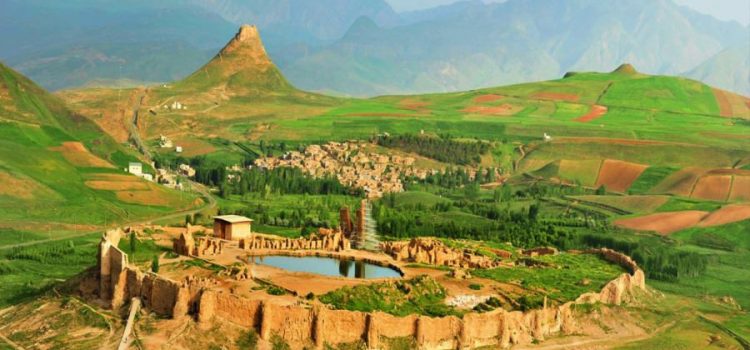
The archaeological site of Takht-e Soleyman, in north-western Iran, is situated in a valley set in a volcanic mountain region. The site includes the principal Zoroastrian sanctuary partly rebuilt in the Ilkhanid (Mongol) period (13th century) as well as a temple of the Sasanian period (6th and 7th centuries) dedicated to Anahita. The site has important symbolic significance. The designs of the fire temple, the palace and the general layout have strongly influenced the development of Islamic architecture.
Brief Synthesis
The archaeological ensemble called Takht-e Soleyman (“Throne of Solomon”) is situated on a remote plain surrounded by mountains in northwestern Iran’s West Azerbaijan province. The site has strong symbolic and spiritual significance related to fire and water – the principal reason for its occupation from ancient times – and stands as an exceptional testimony of the continuation of a cult related to fire and water over a period of some 2,500 years. Located here, in a harmonious composition inspired by its natural setting, are the remains of an exceptional ensemble of royal architecture of Persia’s Sasanian dynasty (3rd to 7th centuries). Integrated with the palatial architecture is an outstanding example of Zoroastrian sanctuary; this composition at Takht-e Soleyman can be considered an important prototype.
An artesian lake and a volcano are essential elements of Takht-e Soleyman. At the site’s heart is a fortified oval platform rising about 60 metres above the surrounding plain and measuring about 350 m by 550 m. On this platform are an artesian lake, a Zoroastrian fire temple, a temple dedicated to Anahita (the divinity of the waters), and a Sasanian royal sanctuary. This site was destroyed at the end of the Sasanian era, but was revived and partly rebuilt in the 13th century. About three kilometres west is an ancient volcano, Zendan-e Soleyman, which rises about 100 m above its surroundings. At its summit are the remains of shrines and temples dating from the first millennium BC.
Takht-e Soleyman was the principal sanctuary and foremost site of Zoroastrianism, the Sasanian state religion. This early monotheistic faith has had an important influence on Islam and Christianity; likewise, the designs of the fire temple and the royal palace, and the site’s general layout, had a strong influence on the development of religious architecture in the Islamic period, and became a major architectural reference for other cultures in both the East and the West. The site also has many important symbolic relationships, being associated with beliefs much older than Zoroastrianism as well as with significant biblical figures and legends.
The 10-ha property also includes Tepe Majid, an archaeological mound culturally related to Zendan-e Soleyman; the mountain to the east of Takht-e Soleyman that served as quarry for the site; and Belqeis Mountain 7.5 km to the northeast, on which are the remains of a Sasanian-era citadel. The archaeological heritage of the Takht-e Soleyman ensemble is further enriched by the Sasanian town (which has not yet been excavated) located in the 7,438-ha landscape buffer zones.
Criterion (i):Takht-e Soleyman is an outstanding ensemble of royal architecture, joining the principal architectural elements created by the Sasanians in a harmonious composition inspired by their natural context.
Criterion (ii):The composition and the architectural elements created by the Sasanians at Takht-e Soleyman have had strong influence not only in the development of religious architecture in the Islamic period, but also in other cultures.
Criterion (iii):The ensemble of Takht-e Soleyman is an exceptional testimony of the continuation of cult related to fire and water over a period of some two and half millennia. The archaeological heritage of the site is further enriched by the Sasanian town, which is still to be excavated.
Criterion (iv):Takht-e Soleyman represents an outstanding example of Zoroastrian sanctuary, integrated with Sasanian palatial architecture within a composition, which can be seen as a prototype.
Criterion (vi): As the principal Zoroastrian sanctuary, Takht-e Soleyman is the foremost site associated with one of the early monotheistic religions of the world. The site has many important symbolic relationships, being also a testimony of the association of the ancient beliefs, much earlier than the Zoroastrianism, as well as in its association with significant biblical figures and legends.
Integrity
Within the boundaries of the property are located the known elements and components necessary to express the Outstanding Universal Value of the property, including the lake and the volcano, archaeological remains related to the Zoroastrian sanctuary, and archaeological remains related to the royal architecture of the Sasanian dynasty. Masonry rooftops have collapsed in some areas, but the configurations and functions of the buildings remain evident.
The region’s climate, particularly the long rainy season and extreme temperature variations, as well as seismic action represent the major threats to the integrity of the original stone and masonry materials. Potential risks in the future include development pressures and the construction of visitor facilities in the buffer zones around the sites. Furthermore, there is potential conflict between the interests of the farmers and archaeologists, particularly in the event that excavations are undertaken in the valley fields.
Authenticity
The Takht-e Soleyman archaeological ensemble is authentic in terms of its forms and design, materials and substance, and location and setting, as well as, to a degree, the use and the spirit of the fire temple. Excavated only recently, the archaeological property’s restorations and reconstructions are relatively limited so far: a section of the outer wall near the southern entrance has been rebuilt, using for the most part original stones recovered from the fallen remains; and part of the brick vaults of the palace structures have been rebuilt using modern brick but in the same pattern as the original. As a whole, these interventions can be seen as necessary, and do not compromise the authenticity of the property, which retains its historic ruin aspect. The ancient fire temple still serves pilgrims performing Zoroastrian ceremonies.
Protection and management requirements
Takht-e Soleyman was inscribed on the national heritage list of Iran in 1931, and it is subject to legal protection under the Law on the Protection of National Treasures (1930, updated 1998) and the Law of the Iranian Cultural Heritage Organization Charter (n. 3487-Qaf, 1988). The inscribed World Heritage property, which is owned by the Government of Iran, is under the legal protection and management of the Iranian Cultural Heritage, Handicrafts and Tourism Organization (which is administered and funded by the Government of Iran). Acting on its behalf, Takht-e Soleyman World Heritage Base is responsible for implementation of the archaeology, conservation, tourism, and education programmes, and for site management. These activities are funded by the Iranian Cultural Heritage, Handicrafts and Tourism Organization, as well as by occasional international support. The current management plan, prepared in 2010, organises managerial strategies and activities over a 15-year period.
Sustaining the Outstanding Universal Value of the property over time will require continuing periodic on-site observations to determine whether the climate or other factors will lead to a negative impact on the Outstanding Universal Value, integrity or authenticity of the property; and employing internationally recognised scientific standards and techniques to properly safeguard the monuments when undertaking stabilisation, conservation, or restoration projects intended to address such negative impacts.
[:de]Die archäologische Stätte Takht-e Suleyman im Nordwesten des Iran liegt in einer vulkanischen Bergregion. Das Gelände umfasst das wichtigste zarathustrische Heiligtum, das teilweise in der Ilkhanidenzeit (13. Jahrhundert) wiederaufgebaut wurde, sowie einen Tempel der Sassanidenzeit (6. und 7. Jahrhundert), der Anahita gewidmet ist. Die Anlage hat eine wichtige symbolische Bedeutung.
Die Entwürfe des Feuertempels, des Palastes und des allgemeinen Grundrisses haben die Entwicklung der islamischen Architektur stark beeinflusst.
Kurze zusammenzetzung
Die archäologische Stätte Takht-e Suleyman im Nordwesten des Iran liegt in einer vulkanischen Bergregion. Das Gelände umfasst das wichtigste zarathustrische Heiligtum, das teilweise in der Ilkhanidenzeit (13. Jahrhundert) wiederaufgebaut wurde, sowie einen Tempel der Sassanidenzeit (6. und 7. Jahrhundert), der Anahita gewidmet ist. Das Gelände hat eine wichtige symbolische Bedeutung. Die Entwürfe des Feuertempels, des Palastes und des allgemeinen Grundrisses haben die Entwicklung der islamischen Architektur stark beeinflusst.
Ein artesischer See und ein Vulkan sind wesentliche Elemente von Takht-e Suleyman. Im Zentrum des Standortes befindet sich eine befestigte ovale Plattform, die sich etwa 60 Meter über der umliegenden Ebene erhebt und etwa 350 Meter mal 550 Meter misst. Auf dieser Plattform befinden sich ein artesischer See, ein zarathustrischer Feuertempel, ein Tempel, der Anahita (der Göttlichkeit der Gewässer) gewidmet ist, und ein sassanianisches königliches Heiligtum. Dieser Ort wurde am Ende der Sassanidenzeit zerstört, aber im 13. Jahrhundert teilweise wieder aufgebaut und wiederbelebt. Ungefähr drei Kilometer westlich von dem Gelände befindet sich ein alter Vulkan. Zendan-e Suleyman erhebt sich etwa 100 m über seiner Umgebung. Auf seinem Gipfel befinden sich die Überreste von Schreinen und Tempeln aus dem ersten Jahrtausend vor Christus.
Kriterium (i): Takht-e Suleyman ist ein herausragendes Ensemble königlicher Architektur, das die wichtigsten architektonischen Elemente der Sassaniden in einer harmonischen Komposition vereint,und von ihrem natürlichen Kontext inspiriert ist.
Kriterium (ii): Die Zusammensetzung und die architektonischen Elemente, die von den Sassanians in Takht-e Suleyman geschaffen wurden, haben nicht nur die Entwicklung der religiösen Architektur in der islamischen Periode, sondern auch andere Kulturen stark beeinflusst.
Kriterium (iii): Das Ensemble von Takht-e Suleyman ist ein außergewöhnliches Zeugnis der Fortdauer des Kultes in Bezug auf Feuer und Wasser in einem Zeitraum von etwa zweieinhalb Jahrtausenden. Das archäologische Erbe des Ortes wird durch die Sassan Stadt, die noch ausgegraben werden muss, noch bereichert.
Kriterium (iv): Takht-e Suleyman stellt ein herausragendes Beispiel des zarathustrischen Heiligtums dar, das in die sassanidische palastartige Architektur in einer Komposition integriert wurde, und als Prototyp angesehen werden kann.
Kriterium (vi): Als wichtigstes zarathustrisches Heiligtum ist Takht-e Soleyman der wichtigste Ort, der mit einer der frühen monotheistischen Religionen der Welt verbunden ist. Der Ort hat viele wichtige symbolische Beziehungen, er ist auch ein Zeugnis der Verbindung der alten Glaubensvorstellungen, viel früher als der Zarathus Integrität
Innerhalb der Grenzen der Anlage befinden sich die bekannten Elemente und Komponenten, die notwendig sind, um den außergewöhnlichen universellen Wert des Grundstücks auszudrücken, einschließlich des Sees und des Vulkans, archäologische Überreste des zarathustrischen Heiligtums und archäologischen königlichen Architektur des Sassaniden Dynastie. Die Dächer von Gemäuern sind in einigen Bereichen eingestürzt, aber die Konfigurationen und Funktionen der Gebäude bleiben offen. Das Klima der Region, insbesondere die lange Regenzeit und die extremen Temperaturschwankungen, sowie Einwirkungen von Erschütterungen sind die größten Bedrohungen für die Integrität der ursprünglichen Materialien aus Stein und Mauerwerk. Zu den möglichen Risiken in der Zukunft gehören Entwicklungsdruck und der Bau von Besuchereinrichtungen in den Pufferzonen um die Standorte herum. Darüber hinaus besteht ein potenzieller Konflikt zwischen den Interessen der Landwirte und Archäologen, insbesondere wenn Ausgrabungen in den Talfeldern vorgenommen werden.
Authentizität
Das archäologische Ensemble Takht-e Suleyman ist authentisch in Bezug auf Formen und Design, Materialien und Substanz, Lage und Umgebung sowie in gewissem Maße auf den Gebrauch und den Geist des Feuertempels. Die erst kürzlich ausgegrabenen Restaurierungen und Rekonstruktionen der archäologischen Anlage sind bisher relativ begrenzt. Ein Teil der äußeren Mauer in der Nähe des südlichen Eingangstors wurde wieder aufgebaut, wobei größtenteils Originalsteine aus den gefallenen Überresten verwendet wurden. Ein Teil der Backsteingewölbe der Palastbauten wurde mit modernen Ziegeln im gleichen Muster wie das Original wieder aufgebaut. Insgesamt können diese Eingriffe als notwendig angesehen werden und beeinträchtigen nicht die Echtheit der Immobilie, die ihren historischen Ruinaspekt beibehält. Der antike Feuertempel dient immer noch Pilgern, die zarathustrische Zeremonien durchführen.
Schutz- und Managementanforderungen
Takht-e Suleyman wurde 1931 in die Liste des nationalen Erbes des Iran eingetragen und unterliegt dem gesetzlichen Schutz der nationalen Schätze (1930, aktualisiert 1998) und des Gesetzes der iranischen Kulturerbe-Organisation (n 3487-Qaf, 1988). Das denkmalgeschützte Weltkulturerbe, das Eigentum der iranischen Regierung ist, steht unter dem rechtlichen Schutz und der Verwaltung der iranischen Organisation für Kulturerbe, Handwerk und Tourismus (die von der iranischen Regierung verwaltet und finanziert wird). In ihrem Auftrag ist Takht-e Suleyman Weltkulturerbe,wo sie für die Umsetzung der Programme für Archäologie, Naturschutz, Tourismus und Bildung sowie für das Management von Baustellen verantwortlich sind. Diese Aktivitäten werden vom iranischen Kulturerbe, der Handwerks- und Tourismusorganisation sowie gelegentlich international finanziell unterstützt. Der aktuelle Managementplan, der 2010 erstellt wurde, organisiert Managementstrategien und -aktivitäten über einen Zeitraum von 15 Jahren.
Um den außergewöhnlichen universellen Wert der Immobilie im Laufe der Zeit aufrecht zu erhalten, müssen regelmäßige Beobachtungen vor Ort durchgeführt werden, um festzustellen, ob das Klima oder andere Faktoren negative Auswirkungen auf den außergewöhnlichen universellen Wert, die Integrität oder die Echtheit der Immobilie haben.Um die Denkmäler bei der Durchführung von Stabilisierungs-, Konservierungs- oder Restaurierungsprojekten angemessen zu schützen,werden international anerkannter wissenschaftlicher, Standards und Techniken angewandt.[:fr][vc_row][vc_column][vc_column_text]
Takht-e Soleyman
Le site archéologique de Takht-e Soleyman, dans le nord-ouest de l’Iran, est situé dans une vallée située dans une région montagneuse volcanique. Le site comprend le principal sanctuaire zoroastrien reconstruit en partie pendant la période Ilkhanide (XIIIe siècle) ainsi qu’un temple de la période sassanide (VIe et VIIe siècles) dédié à Anahita. Le site a une signification symbolique importante. Les dessins du temple du feu, du palais et de la configuration générale ont fortement influencé le développement de l’architecture islamique.
Brève synthèse
L’ensemble archéologique appelé Takht-e Soleyman («trône de Salomon») est situé dans une plaine isolée entourée de montagnes dans la province d’Azerbaïdjan occidental, au nord-ouest de l’Iran. Le site a une forte signification symbolique et spirituelle liée au feu et à l’eau – principale raison de son occupation depuis l’antiquité – et constitue un témoignage exceptionnel de la continuation d’un culte lié au feu et à l’eau pendant une période d’environ 2 500 ans. Ici, dans une composition harmonieuse inspirée par son cadre naturel, se trouvent les vestiges d’un ensemble exceptionnel d’architecture royale de la dynastie Sassanide de Perse (IIIe-VIIe siècles). Intégré à l’architecture du palais est un exemple exceptionnel de sanctuaire zoroastrien; cette composition chez Takht-e Soleyman peut être considérée comme un prototype important.
Un lac de la fontaine Artésien et un volcan sont des éléments essentiels de Takht-e Soleyman. Au cœur du site se trouve une plate-forme ovale fortifiée s’élevant à environ 60 mètres au-dessus de la plaine environnante et mesurant environ 350 m sur 550 m. Sur cette plate-forme se trouvent un lac artésien, un temple du feu zoroastrien, un temple dédié à Anahita (la divinité des eaux) et un sanctuaire royal sassanide. Ce site a été détruit à la fin de l’ère sassanide, mais a été relancé et partiellement reconstruit au XIIIe siècle. Environ trois kilomètres à l’ouest se trouve un ancien volcan, Zendan-e Soleyman(le prison de Soleyman), qui s’élève à environ 100 m au-dessus de ses environs. Au sommet se trouvent les vestiges de sanctuaires et de temples datant du premier millénaire avant notre ère.
Takht-e Soleyman était le principal sanctuaire pour le site du zoroastrisme, la religion d’État sassanide. Cette première religion monothéiste a eu un impact significatif sur l’islam et le christianisme; de même, les dessins du temple du feu et du palais royal, ainsi que l’aménagement général du site, ont fortement influencé l’évolution de l’architecture religieuse à l’époque islamique et sont devenus une référence architecturale majeure pour d’autres cultures, à l’est comme à l’ouest . Le site entretient également de nombreuses relations symboliques importantes, étant associé à des croyances bien plus anciennes que le zoroastrisme ainsi qu’à des personnages et légendes bibliques significatifs.
La propriété de 10 hectare comprend également Tepe Majid, un monticule archéologique lié culturellement à Zendan-e Soleyman; la montagne à l’est de Takht-e Soleyman et la montagne Belqeis, à 7,5 km au nord-est, vestiges d’une citadelle de l’époque sassanide. Le patrimoine archéologique de l’ensemble Takht-e Soleyman est encore enrichi par la ville sassanide (qui n’a pas encore été fouillée) située dans les zones paysagères de 7 438 hectares.
Critère (i): Takht-e Soleyman est un ensemble exceptionnel d’architecture royale joignant les principaux éléments architecturaux créés par les Sassanide dans une composition harmonieuse inspirée par leur contexte naturel.
Critère (ii): La composition et les éléments architecturaux créés par les Sasanide à Takht-e Soleyman ont eu une forte influence non seulement sur le développement de l’architecture religieuse de la période islamique, mais également sur celle des autres cultures.
Critère (iii): L’ensemble de Takht-e Soleyman est un témoignage exceptionnel de la continuation du culte lié au feu et à l’eau sur une période de quelque deux mille cinq cents ans. Le patrimoine archéologique du site est enrichi par la ville sassanide, qui reste à fouiller.
Critère (iv): Takht-e Soleyman représente un exemple exceptionnel de sanctuaire zoroastrien, intégré à une architecture de palais sassanide dans une composition, qui peut être considérée comme un prototype.
Critère (vi): En tant que principal sanctuaire zoroastrien, Takht-e Soleyman est le site le plus important associé à l’une des premières religions monothéistes du monde. Le site entretient de nombreuses relations symboliques importantes, témoignant également de l’association d’anciennes croyances, bien avant le zoroastrisme, ainsi que d’associations avec d’importantes figures et légendes bibliques.
Intégrité
Les éléments et composants connus permettant d’exprimer la valeur universelle exceptionnelle du bien, y compris le lac et le volcan, se trouvent dans les limites du bien, ainsi que des vestiges archéologiques liés au sanctuaire zoroastrien et des vestiges archéologiques liés à l’architecture royale de la dynastie sassanide. Les toits de maçonnerie se sont effondrés dans certaines zones, mais les configurations et les fonctions des bâtiments restent évidentes.
Le climat de la région, en particulier la longue saison des pluies et les variations extrêmes de température, ainsi que l’action sismique constituent les principales menaces pour l’intégrité des matériaux de pierre et de maçonnerie d’origine. Les risques potentiels à l’avenir comprennent les pressions liées au développement et la construction d’installations pour les visiteurs dans les zones tampons autour des sites. En outre, il existe un conflit potentiel entre les intérêts des agriculteurs et des archéologues, en particulier dans le cas où des fouilles sont entreprises dans les champs de la vallée.
Authenticité
L’ensemble archéologique de Takht-e Soleyman est authentique par ses formes et sa conception, ses matériaux et sa substance, son emplacement et son cadre, ainsi que, dans une certaine mesure, par l’usage et l’esprit du temple du feu. Récemment excavées, les restaurations et reconstructions du bien archéologique sont relativement limitées à ce jour: une partie du mur extérieur près de l’entrée sud a été reconstruite, en utilisant pour la plupart des pierres d’origine récupérées des restes tombés; et une partie des voûtes en brique des structures du palais ont été reconstruites à l’aide de briques modernes, mais selon le même schéma que l’original.Dans l’ensemble, ces interventions peuvent être considérées comme nécessaires et ne compromettent pas l’authenticité du bien, qui conserve son aspect de ruine historique. L’ancien temple du feu accueille encore des pèlerins lors de cérémonies zoroastriennes.
Exigences de protection et de gestion
Takht-e Soleyman a été inscrit sur la liste du patrimoine national de l’Iran en 1931 et il est soumis à la protection légale conférée par la loi sur la protection des trésors nationaux (1930, mise à jour en 1998) et la charte du droit iranien à la protection du patrimoine culturel (n 3487-Qaf, 1988). Le bien inscrit au patrimoine mondial, qui appartient au gouvernement iranien, est sous la protection juridique et la gestion de l’Organisation iranienne pour le patrimoine culturel, l’artisanat et le tourisme (qui est administrée et financée par le gouvernement iranien). Agissant en son nom, la base du patrimoine mondial de Takht-e Soleyman est responsable de la mise en œuvre des programmes d’archéologie, de conservation, de tourisme et d’éducation, ainsi que de la gestion du site. Ces activités sont financées par l’Organisation iranienne du patrimoine culturel, de l’artisanat et du tourisme, ainsi que par un appui international occasionnel. Le plan de gestion actuel, préparé en 2010, organise des stratégies et des activités de gestion sur une période de 15 ans.
Le maintien de la valeur universelle exceptionnelle du bien au fil du temps nécessitera des observations périodiques sur place afin de déterminer si le climat ou d’autres facteurs auront un impact négatif sur la valeur universelle exceptionnelle, l’intégrité ou l’authenticité du bien; et en appliquant des normes et techniques scientifiques reconnues sur le plan international pour protéger correctement les monuments lors de la réalisation de projets de stabilisation, de conservation ou de restauration destinés à remédier à ces impacts négatifs.
[/vc_column_text][/vc_column][/vc_row][:]